
Build a Clean Core: Why Enterprise Agility Starts with Architecture
Enterprise platforms do not become complex overnight. They become complex one customization at a time, and each one looked reasonable on the day it was approved.
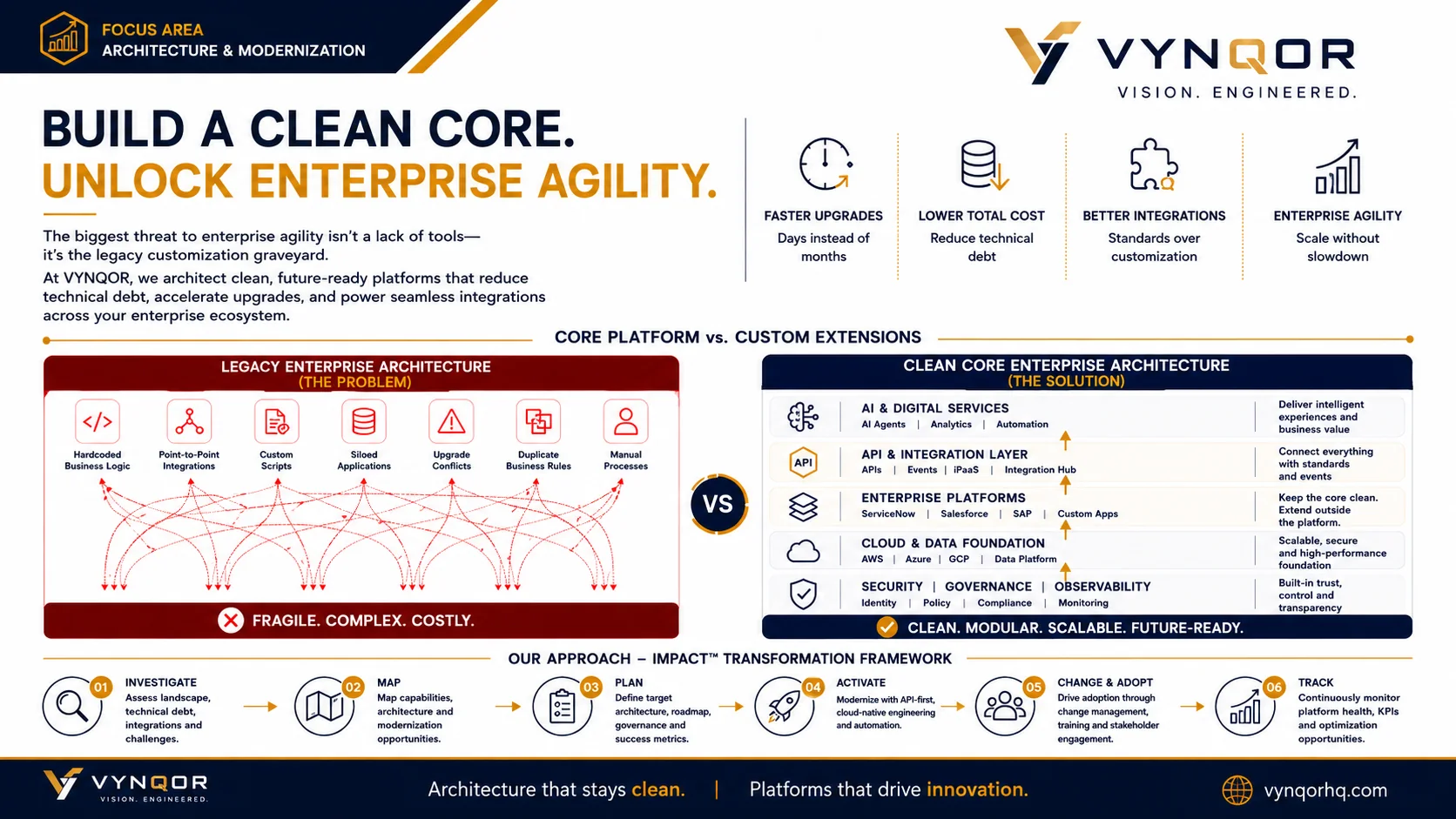
Every hardcoded script. Every point-to-point integration. Every duplicate business rule. Every quick fix. Individually harmless, collectively they form a layer of technical debt that quietly removes the agility the platform was bought for.
What starts as a small customization to meet an immediate need becomes an architectural constraint on every future release, integration and innovation initiative. Eventually organizations spend more time maintaining their platforms than getting value from them.
The hidden cost of technical debt
Technical debt is not a technology concern with technology consequences. It shows up on the business ledger:
- Longer release and upgrade cycles
- Fragile integrations that need constant maintenance
- Rising operational cost
- Reduced platform scalability
- Duplicate business logic across applications
- Difficulty adopting new platform capability
- Slower delivery of business initiatives
The platform stops being an accelerator and becomes the bottleneck everything else queues behind.
Why traditional architectures struggle
Most enterprise implementations drift toward tight coupling, with business logic living inside the core platform itself: hardcoded workflows, platform-specific customizations, point-to-point integrations, duplicated validation rules, manual operational processes, siloed applications and inconsistent governance.
Each of those solved a real problem at the time. Together they make every subsequent modernization harder and more expensive than the last.
What a clean core actually is
A clean core architecture preserves the integrity of the platform by keeping unnecessary customization out of the core application. Business intelligence moves into reusable, loosely coupled services rather than being embedded where it blocks upgrades.
- API-first integration
- Cloud-native architecture
- Event-driven communication
- Reusable business services
- Standardized enterprise integrations
- Low-code and configuration-first extensibility
- Centralized governance and observability
Keep the enterprise platform clean, and innovate around it rather than inside it.
What changes in practice
The business case
Organizations that adopt a clean core strategy consistently report the same set of gains: upgrade cycles compressed from months to weeks, lower total cost of ownership as maintenance overhead falls, faster response to changing business needs without disturbing core functionality, simpler enterprise connectivity, centralized governance and observability, and the ability to adopt AI, automation and analytics without a re-platforming exercise first.
How VYNQOR delivers it
Modernization needs a structured framework, not just a target architecture. Every engagement runs on VynImpact™, our IMPACT methodology:
- Investigate - assess the landscape, technical debt, integration complexity and business objectives
- Map - define the future-state architecture, platform boundaries and modernization roadmap
- Plan - prioritize initiatives, establish governance and align execution to business outcomes
- Activate - modernize with API-first engineering, cloud-native services and enterprise integration practice
- Change & Adopt - drive adoption through change management, stakeholder engagement and training
- Track - monitor platform health, business KPIs, adoption and optimization opportunities
The approach applies equally to ServiceNow, SAP, Salesforce, Microsoft Dynamics or any other enterprise platform, because the discipline is architectural rather than product-specific.
Final thoughts
Enterprise agility begins with architectural discipline.
Every customization should be intentional. Every integration should be reusable. Every modernization initiative should reduce complexity rather than add to it. Sustainable transformation starts with a clean core.
Making a platform decision?
We evaluate platforms against your operating model, integration landscape and transformation roadmap - not a feature matrix.