
Beyond Requirements: Engineering Business Value
A requirement tells you what to build. A business outcome tells you why. Most transformation programs are scoped entirely on the first and measured entirely on the second.
Organizations today have access to powerful enterprise platforms, cloud, AI, automation and digital engineering capability. Yet most transformation programs still open with the same question: what are your requirements?
Requirements matter. They are not the destination. A requirement tells us what needs to be built. A business outcome tells us why it needs to be built, and the gap between those two is where most programs quietly lose their value.
From requirements to outcomes
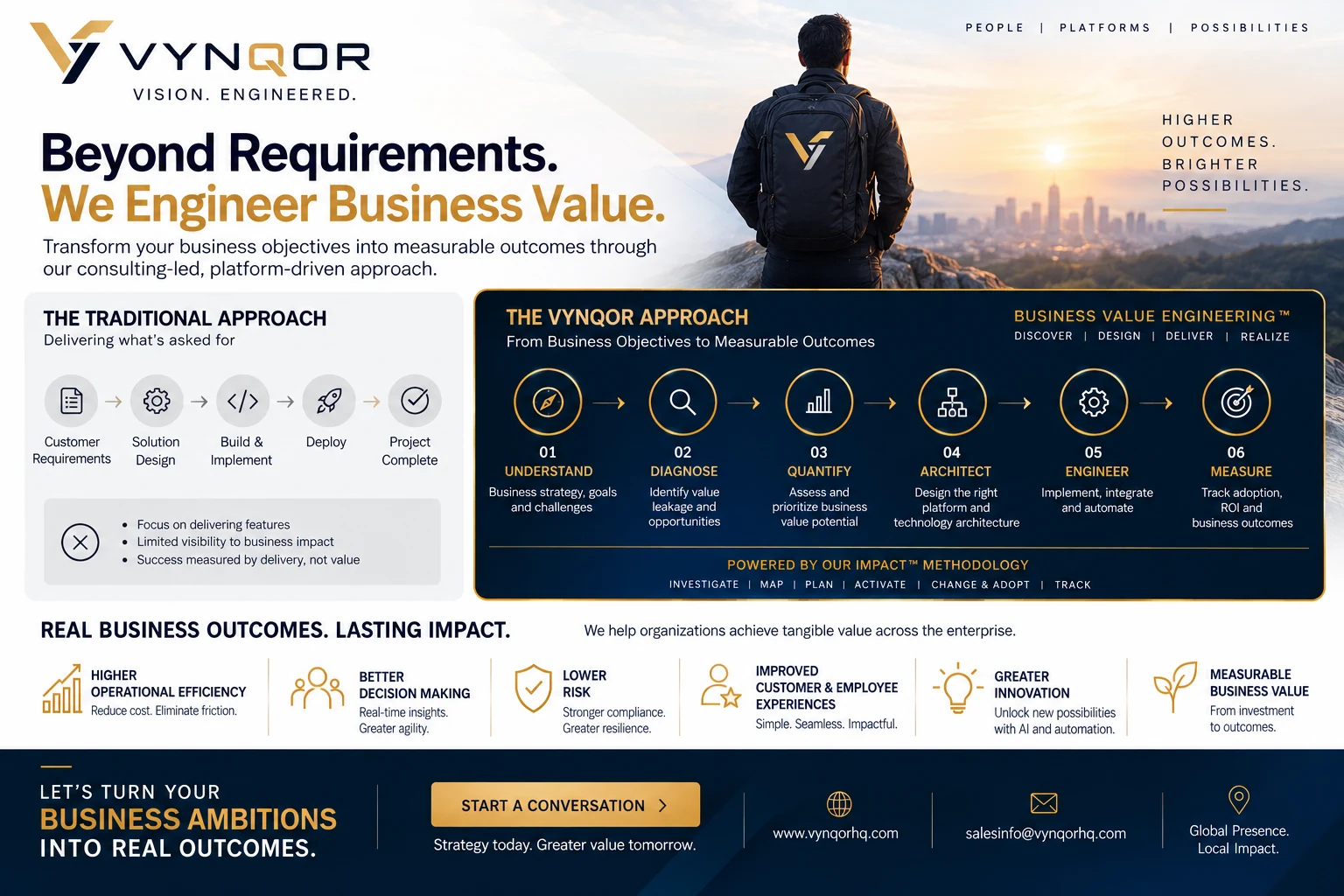
A traditional engagement runs requirements, then solution design, then build, then deploy. It reliably delivers the functionality that was asked for. Delivering functionality is not the same as delivering value.
Starting from the business objective changes the sequence: objective, value opportunity, architecture, engineering, adoption, outcome. It also changes the question being answered, from what should we build to what should improve because we built it.
What should be different for your business when we are finished?
What Business Value Engineering means
Business Value Engineering is our approach to connecting business objectives with technology investment and measurable outcomes. It brings together business strategy, value identification, enterprise architecture, platform engineering, data and integration, AI and automation, change and adoption, and benefits measurement.
The objective is narrow and deliberate: ensure technology investment is designed to create measurable business value, not only to deliver capability.
The six stages
01 Understand
Start with the business. Strategic objectives, business priorities, operating challenges, customer and employee expectations, and the technology landscape already in place. Before platforms or features are discussed, understand what the organization is trying to achieve.
02 Diagnose
Identify where value is being lost rather than simply documenting the current process. Value leakage usually shows up as:
- Process inefficiency and manual effort
- Fragmented data and technology silos
- Decision latency and poor visibility
- Operational risk carried without an owner
- Low adoption of capability already paid for
03 Quantify
Assess and prioritize the value potential, so that sequencing follows business value and feasibility rather than whichever function asked loudest.
04 Architect
Design the future state around the desired outcome, across business, enterprise, platform, integration, data and AI architecture. Technology choices follow the business objective, not the other way around.
05 Engineer
Turn the architecture into reality, bringing platforms, applications, integrations, automation, AI and cloud engineering together to build the capability the outcome requires.
06 Measure
Transformation does not end at go-live. The question that matters is whether the investment created the value expected of it: operational efficiency, productivity, cost, decision velocity, risk reduction, customer and employee experience, adoption, revenue enablement.
Go-live is a milestone. Value realization is the objective.
A program that reaches go-live on time and cannot evidence what improved has delivered a system, not an outcome.
What this looks like in practice
Consider an organization that opens with a clear request: we need ServiceNow SPM. A traditional conversation moves immediately to modules, workflows, integrations and dashboards.
Asking why first surfaces a different picture. Strategic investments are hard to prioritize. Portfolio decisions take too long. Resources are not aligned to strategic priorities. Executives have no consolidated portfolio view. Benefits are not tracked consistently.
The real objective turns out to be improving investment prioritization, portfolio visibility and strategic decision-making. The platform becomes the enabler of that outcome rather than the outcome itself, and the success criteria change accordingly.
The same principle across every platform
The technology differs. The principle does not.
Powered by IMPACT
Business Value Engineering is not a separate methodology running alongside delivery. It maps onto the six phases of VynImpact, which is how value stays in the conversation past the strategy phase.
- Investigate: understand the business objective
- Map: identify processes, capabilities, dependencies and value leakage
- Plan: prioritize initiatives on business value and feasibility
- Activate: engineer and deploy the required capability
- Change & Adopt: drive adoption and organizational change
- Track: measure outcomes, adoption and value realization
Transformation becomes a continuous value cycle rather than a one-time implementation.
From system implementation to value engineering
The objective is not to replace requirements. It is to put them in the right context.
The question worth asking
Technology partners have traditionally been measured on their ability to deliver projects. The more meaningful measure is the value created through them.
Understand the ambition. Engineer the capability. Measure the outcome. That is Business Value Engineering, and it starts by replacing one question with another: not what do you need us to build, but what should be different for your business when we are finished.
Making a platform decision?
We evaluate platforms against your operating model, integration landscape and transformation roadmap - not a feature matrix.