
The Biggest Challenge in Enterprise AI Is Not the Technology
Enterprises are investing heavily in LLMs, agents and RAG pipelines. The barrier to success is rarely model capability. It is the architectural friction of governing AI at scale.
AI is moving from sandbox experimentation to production-grade integration faster than governance models are adapting. Three challenges now decide whether that becomes a competitive advantage or an operational liability, and none of them are solved by choosing a better model.
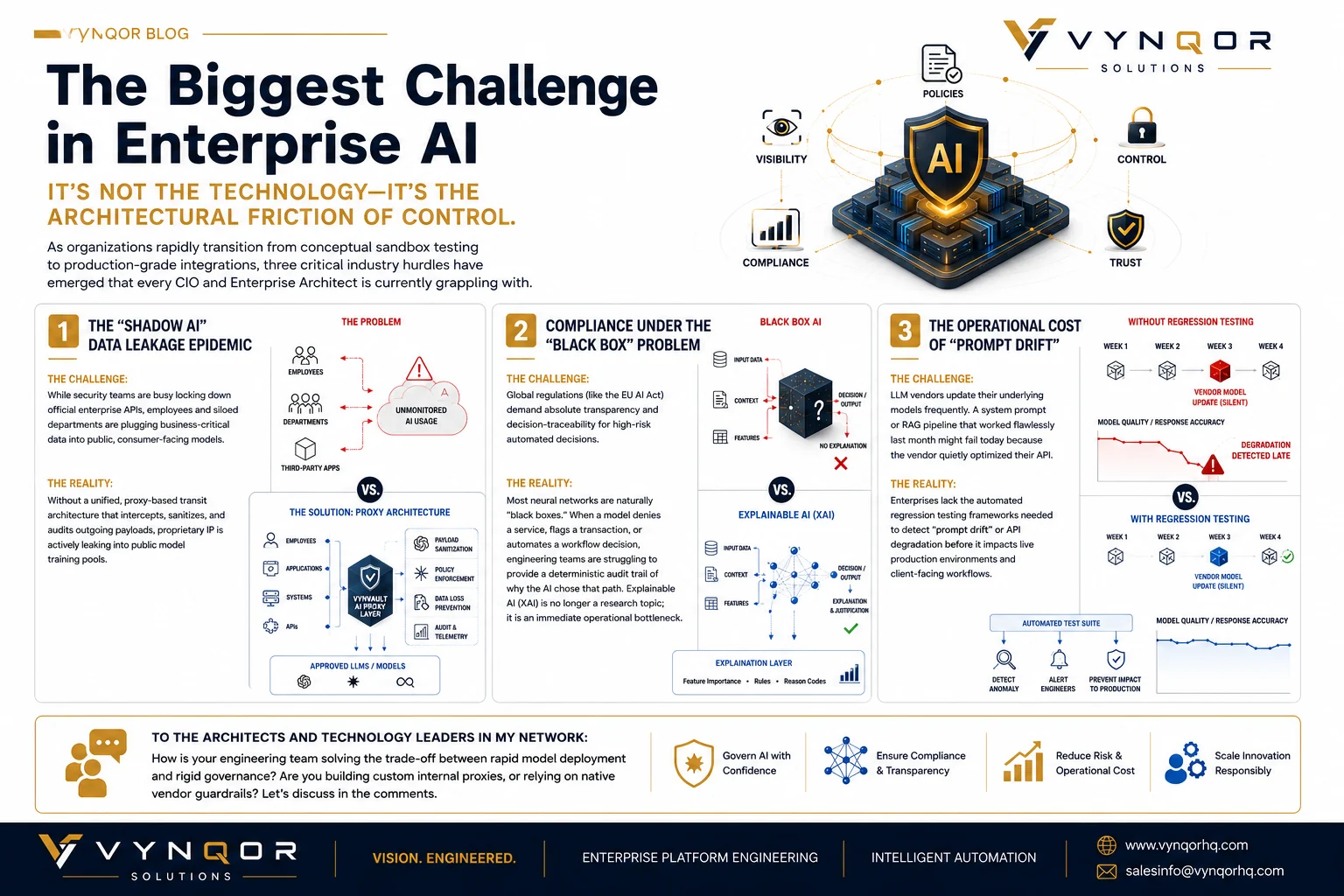
Three challenges that decide the outcome
1. Shadow AI and invisible data leakage
While security teams lock down official enterprise APIs, business users are pasting proprietary material into consumer-facing models to get their work done faster. It is not malicious. It is what happens when the approved path is slower than the unapproved one.
- Business users adopting unapproved AI tools
- Sensitive data leaving enterprise boundaries
- No visibility of AI usage across departments
The response is architectural, not a policy memo: a proxy-based AI gateway that intercepts, sanitises, monitors and audits every outbound interaction while enforcing enterprise security policy in transit.
2. The black box compliance problem
The EU AI Act, ISO 42001 and the NIST AI Risk Management Framework have shifted the regulatory focus from building AI to governing it. Most neural networks are naturally opaque, so when a model denies a service, flags a transaction or automates a workflow decision, engineering teams struggle to produce a deterministic audit trail of why.
Explainable AI has stopped being a research topic and become an operational bottleneck. Model lineage, decision traceability and reason codes are now baseline requirements in regulated industries, not enhancements.
3. Prompt drift and silent model regression
Foundation model vendors update their models continuously, often without announcement. A system prompt or RAG pipeline that performed accurately last month can behave differently today with no change to your application code.
Without automated regression testing, drift is discovered by a customer, an auditor or a regulator rather than by a test suite. The fix is unglamorous and well understood: continuous regression testing, model monitoring and automated validation pipelines that catch degradation before it reaches production.
What changes when governance is engineered
Governance has to become an engineering discipline
Enterprise AI success depends on more than model selection. It requires an architectural foundation providing:
- AI inventory and discovery
- Policy enforcement
- Secure AI gateway and proxy
- Explainable AI
- AI risk management
- Continuous compliance
- Model monitoring
- Automated regression testing
These are the capabilities we built VynVault™ to operationalise, precisely because treating them as a periodic compliance exercise does not survive contact with production AI.
The question is no longer how quickly we can deploy AI. It is how we deploy AI securely, responsibly, and at enterprise scale.
How VYNQOR helps
We help enterprises design, govern and scale AI through architecture-led transformation:
- AI strategy and advisory
- AI governance and compliance
- Enterprise AI architecture
- AI security and risk management
- AI platform engineering
- LLMOps and AI operations
- AI control towers and governance platforms
- Intelligent automation
The road ahead
The future belongs to organizations that balance innovation with governance.
Not the ones that deploy fastest, and not the ones that govern so tightly nothing ships. The ones that make the governed path the fastest path will build trust, accelerate adoption, and hold on to the value.
Making a platform decision?
We evaluate platforms against your operating model, integration landscape and transformation roadmap - not a feature matrix.